English edition
Who Is More Barbaric — Russia or Iran?
26 November 2026
By Maria Arkhipova
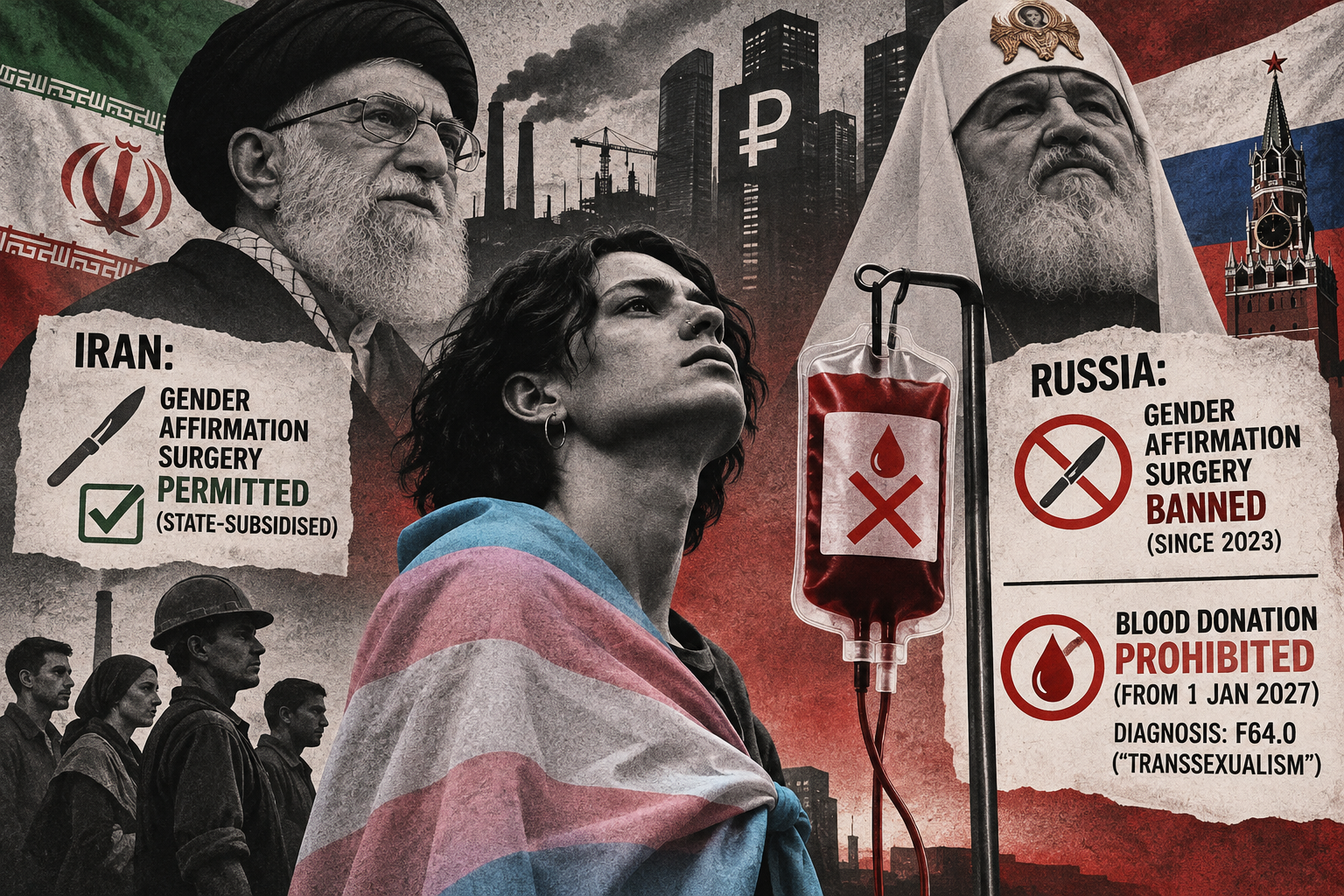
I recently wrote about religious barbarism in Iran as an instrument of class domination over the individual. Yet even in theocratic Iran, medical correction of sex characteristics is permitted, and the state even subsidises such procedures. In capitalist Russia, medical transition has been prohibited since 2023, and from 1 January 2027, a diagnosis of “transsexualism” (F64.0 under ICD-10) will constitute grounds for permanent deferral from blood donation.
It follows that in Russia, an individual’s gender identity now affects even the possibility of using their blood to save another person’s life. What does gender identity have to do with the biological properties of blood? Since when have religious conceptions of the individual become a medical criterion?
The comparison with Iran is particularly revealing because it demonstrates the arbitrary nature of religious dogmas serving the interests of the ruling class. In one state, the religious superstructure justifies the medical correction of sex characteristics; in the other, it prohibits it. Despite the contradictory nature of these prescriptions, both are united by the state’s appropriation of the right to exercise control over the individual’s body.
The economic domination of one class over another extends into the political, legal and religious superstructure. The reproduction of class domination requires a society in which the subordination of the individual is perceived as a natural condition and individual freedom as something granted by the authorities. This is precisely the function of the religious superstructure, which transforms relations of domination and subordination into moral norms.
Instead of struggling against their own economic and political deprivation, working people are encouraged to fight against the rights of other individuals. Those alienated from the means of production and the products of their own labour are offered a sense of superiority over others solely on the basis of sex, nationality, religion or gender identity. Thus, class solidarity is replaced by social hostility, while the interests of the ruling class are presented to society as the defence of morality.
However, the individual is not part of the ideological superstructure. The individual is an objectively existing subject of the material world, possessing their own needs, interests, will, rights and freedoms. The right to exercise control over one’s own body and determine one’s own life belongs to the individual.
Herein lies the contradiction of modern capitalist civilisation: the development of the productive forces and science creates ever greater opportunities for individual emancipation, while the class superstructure continues to reproduce the individual’s subordination, including through medieval religious beliefs.
In the case of blood donation, religious obscurantism comes into direct conflict with material reality, the objective laws of biology, individual rights and the very purpose of medicine — the preservation of life.
On 1 January 2027, the biological properties of a transgender individual’s blood will remain unchanged. What will change is the legal superstructure, which will create an obstacle to the use of potentially suitable donor blood to save lives.
Such is the outcome of the restoration of capitalism in Russia: an economic base founded on class exploitation has produced a reactionary superstructure that has extended its power even to blood donation. In a twenty-first-century society, religious obscurantism is elevated to the status of a medical criterion, while the interests of class domination are placed above the rights, freedoms and very life of the individual.